

• There are no suggestions because the search field is empty.

Typically, grid data is spread across various systems, such as GIS, ERP or EDM. To perform grid simulations, this data often has to be consolidated and validated manually, making it difficult to gain full transparency of the grid load across voltage levels. At the same time, integrating distributed generators and consumers requires a more detailed analysis of available grid capacity and a deeper understanding of current grid conditions.

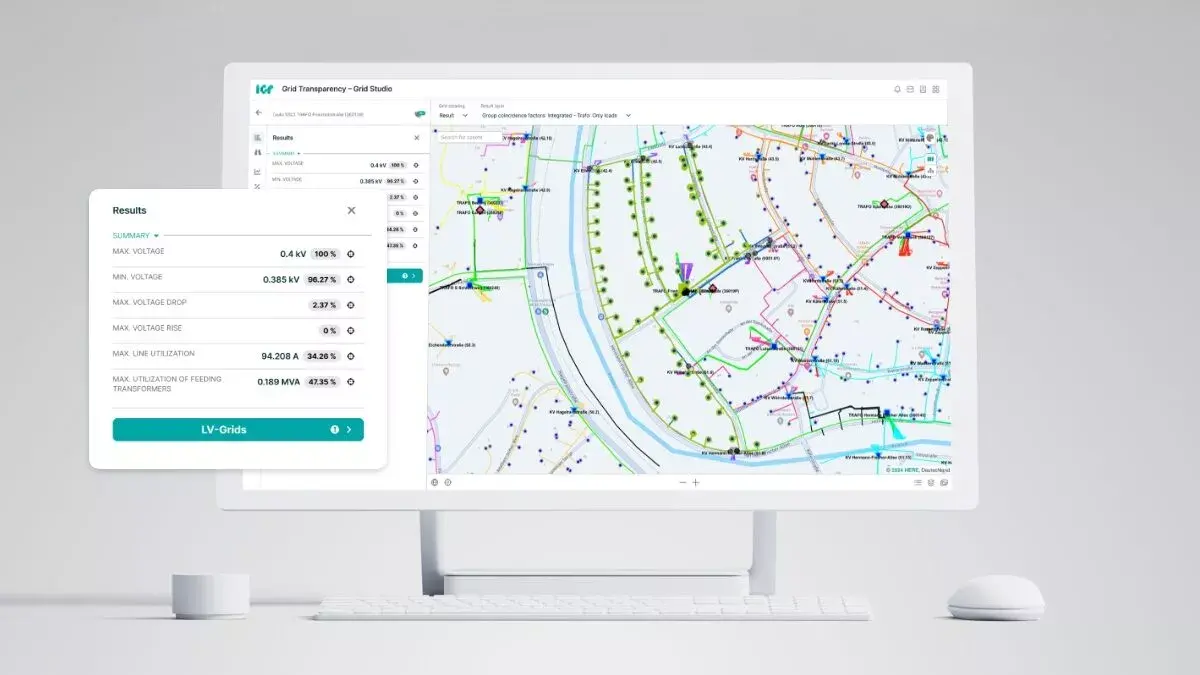
The Grid Transparency app provides a solution to this challenge by offering insights into a complete, centralized, and computable grid model that covers all voltage levels. All grid parameters, such as asset data, switch states, and supply task information, can be accessed in one central location. The criticality check lets you identify critical grids early on: Overloaded grids or grids at risk of congestion are systematically visualized, creating a solid basis for monitoring and measure planning.

Load flow simulations and short-circuit analyses are performed automatically whenever data is updated. The results provide detailed insights into the grid load and support planning measures, such as prioritizing grid reinforcement measures or deploying measurement infrastructure to validate utilization with real-world measurement data.

What you can do with the Grid Transparency app

The app automates the management of the current grid model and provides a solid foundation for all grid calculations, including grid load evaluations through the criticality check.

Comprehensive visualization options

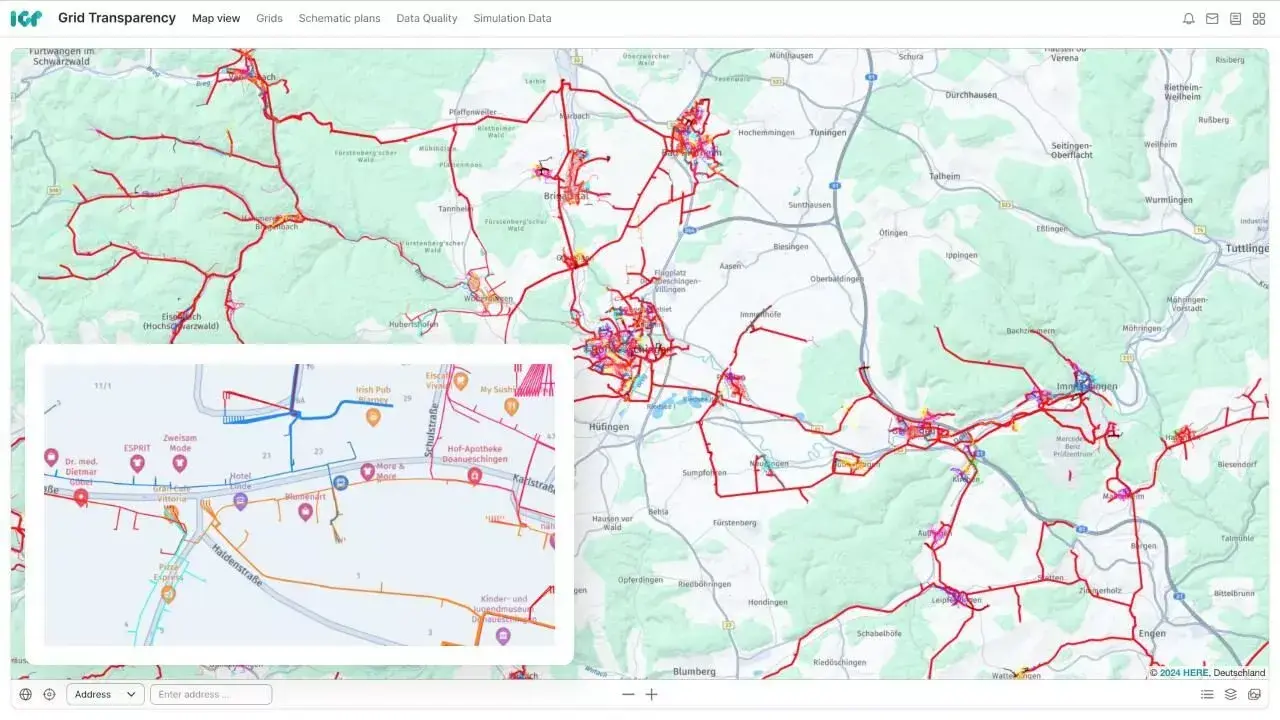
Our app provides a detailed, map-based view of the entire grid area, allowing you to clearly distinguish between different voltage levels, as well as the specific sections and feeders in the grid. You can also integrate additional maps and data sources into the visualization and use a schematic representation to quickly understand the grid topology.
Automated simulations for the entire grid

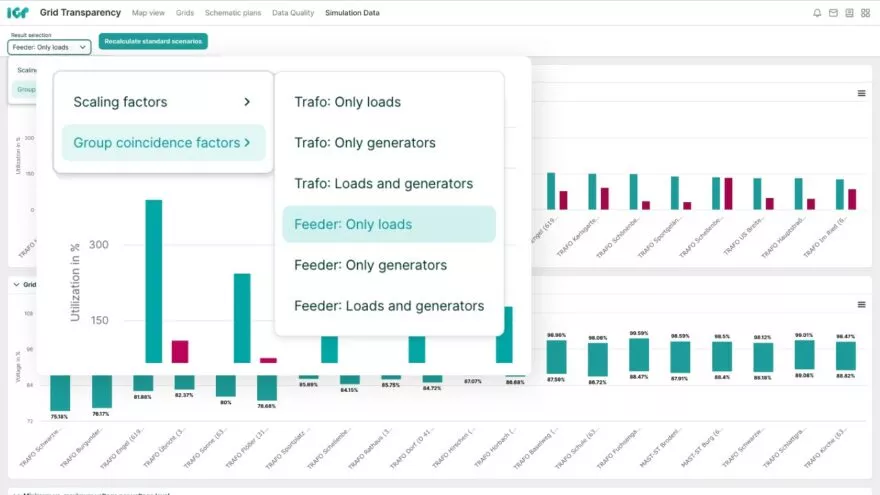
The grid load and voltage curves of each asset are automatically assessed across all grids based on your planning principles, using simulations based on either coincidence factors or time series. You can also perform short-circuit analyses. Together, this provides a comprehensive view of the overall situation in the grid.
Advanced parameterization and comprehensive asset evaluation

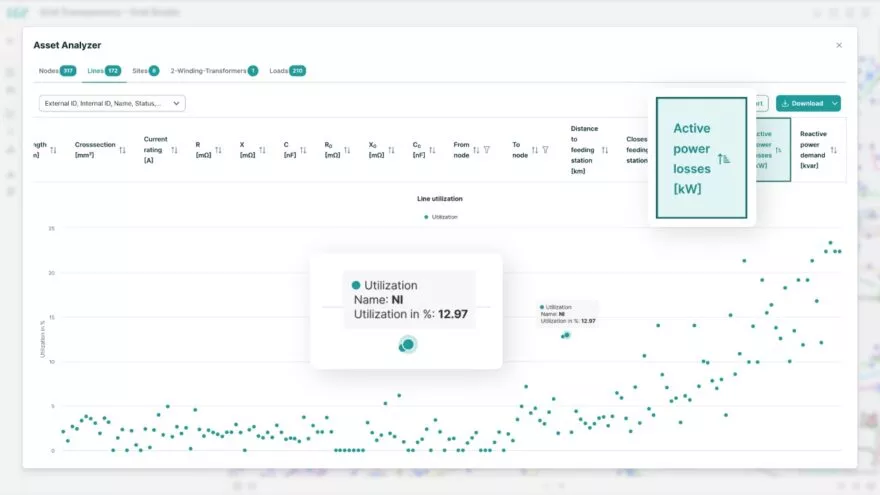
Thanks to flexible parameterization options for key inputs, such as coincidence factors and limit values, you can tailor simulations precisely to the actual conditions of the grid. In addition, you receive detailed information about each asset in the grid, including all technical asset parameters, extreme values, and frequency distributions. The values are presented in a table and sorted by asset type. These insights facilitate a thorough evaluation of the grid load and help monitor critical areas in the grid.
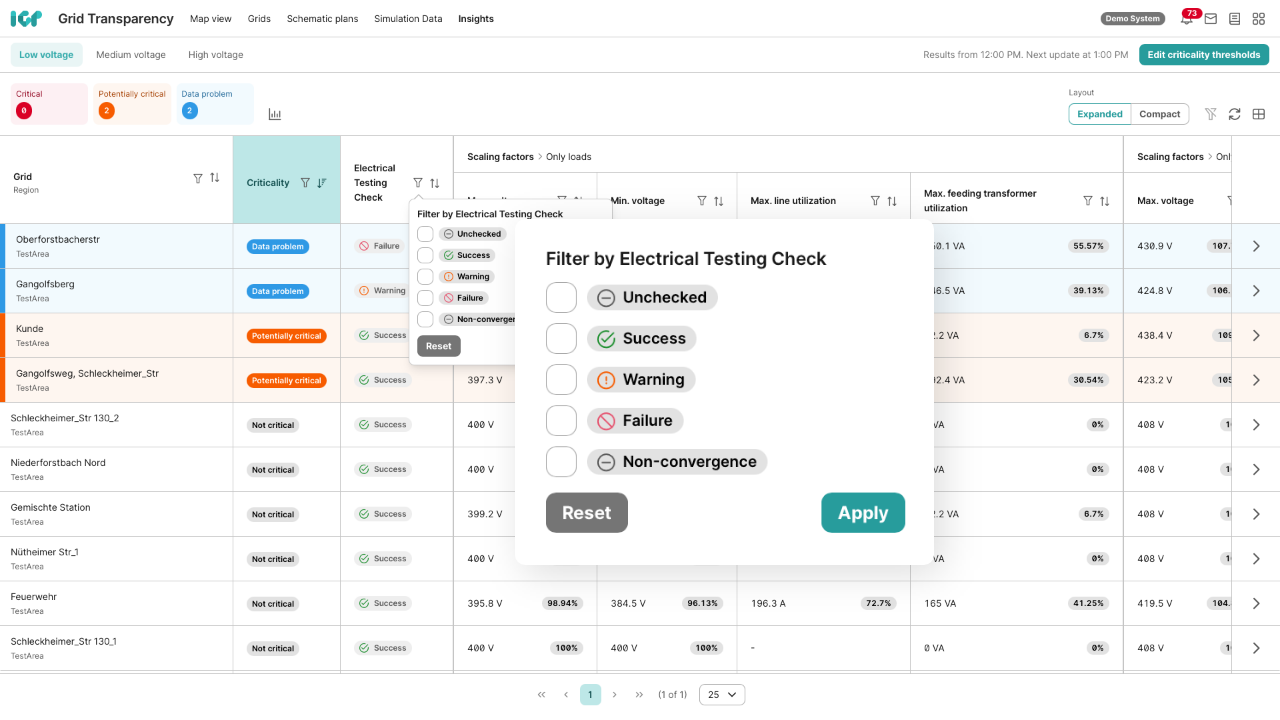
Criticality check: Centralized overview and monitoring of all grids

Our app offers a centralized overview of all relevant grid information from planning and operations, enabling criticality evaluation and status tracking for your grids. Color-coded criticality levels help you identify appropriate measures and focus operational attention on relevant areas.

By filtering and sorting the data, you can analyze and prioritize specific grid areas. Important values, such as transformer and line utilization, are presented in a clear, easy-to-read table. Based on the results of the electrical testing, you can quickly identify vulnerabilities in the grid. This helps you assess the quality of the grid, identify potential issues early on, and determine appropriate measures, supporting targeted resource planning instead of a scattershot approach.

Already convinced? Then contact us for more information and a live walk-through:

Not entirely sure yet? Read on!

How our app for grid load evaluation supports your work:

All grid data in one place

All grid data in one place

Our app brings together all relevant grid data and makes it accessible in a single, centralized location. This way, it provides a comprehensive overview of the entire grid, significantly simplifies many workflows, and facilitates a detailed analysis of both grid structure and grid load.

Advanced analyses

Advanced analyses

By integrating various data silos, our app facilitates comprehensive analyses and simulations, using a centralized data basis. This includes hosting capacity and criticality evaluations, as well as various grid simulations, providing a solid foundation for precise and informed decision-making.

Improved grid planning

Improved grid planning

Evaluating the current grid load provides crucial insights for grid planning. Congestion can be identified early on, even without a measurement infrastructure. This helps prioritize grid expansion measures and make better use of available financial and personnel resources.

Want to see our tool for grid load visualization and evaluation of available grid capacity?

Then send us a quick note, and we’ll get in touch with you as quickly as possible!

Contact person

Dr. Tobias Falke
VP Global Sales & Marketing

Dr. Tobias Falke

Frequently Asked Questions About Our App for Grid Load Visualization:

How does the criticality check work?

During the criticality check, a large number of grids is analyzed automatically. The IGP evaluates existing values, such as transformer and line utilization, based on customizable thresholds. Using these thresholds, the IGP sorts the grids into different criticality levels. The criticality levels indicate whether an action is required for a certain grid. Grids that contain data issues and therefore cannot be evaluated reliably are highlighted accordingly.

What are the benefits of envelio's criticality check?

Above all, the criticality check provides distribution system operators with improved prioritization, transparency, and predictability. The ability to identify critical grids early on is a real advantage: Overloaded grids or grids at risk of congestion are systematically visualized, creating a solid basis for monitoring and measure planning.⁠

By automatically sorting grids into criticality levels, the criticality check helps focus measures, analyses, and operational attention on relevant areas, supporting targeted resource and measure planning instead of a scattershot approach. The transparent labeling of data issues also increases transparency and improves decision quality, making it clear where data quality must be improved before final decisions can be made.

Another advantage is that the history and effects of changes can be accessed at any time, providing insights into how criticality has changed over time and how threshold adjustments influence the distribution of grids across criticality levels.

Which voltage levels can I represent with the Grid Transparency app?

You can represent the entire supply area in a single, unified grid model, from the primary substation all the way to the end user. The app allows cross-voltage-level simulations that take into account the interactions between different voltage levels, helping you analyze the grid load across voltage levels and initiate targeted planning measures if necessary.

Which data sources can be integrated into the Grid Transparency app?

You can merge data from all relevant source systems. You can, for example, merge geo data, information on individual grid assets, and data on grid participants, such as households, PV systems, heat pumps, or EV charging stations. Common source systems include geographic information systems (GIS), asset management systems, energy data management (EDM), and enterprise resource planning (ERP). These comprehensive data sets form the basis for detailed grid planning analyses and provide valuable insights for grid load visualization and preventive control.

How can the app support me in integrating renewables into my grid?

The app provides a detailed analysis of the current grid capacity, allowing you to better plan the integration of renewable energy sources and assess the impact of new grid participants across the entire grid — even across voltage levels. You can also use the app to evaluate the grid load and grid capacity in advance, preventing congestion early on.