
DE

    envelio Roadshow | November 2026
    Tausche dich mit anderen kleineren VNBs aus und erfahre aus der Praxis, wie du deinen Netzbetrieb trotz wachsender Anforderungen robust weiterentwickelst.

    👉 Jetzt anmelden

    Wer heute ein Niederspannungsleitsystem einführen will, fragt sich oft: Was muss das System wirklich können?

    Reicht ein rechenfähiges Netzmodell mit Messdatenintegration und Netzzustandsermittlung? Welche Funktionen sind für §14a EnWG sowie für §12 EnWG und §9 EEG zwingend notwendig? Welche Daten und Schnittstellen müssen vorhanden sein? Und was davon muss vor dem Projektstart intern geklärt werden?

    Genau hier fehlt häufig ein belastbarer Orientierungsrahmen.

    Unsere Checkliste hilft all diese Fragen in eine klare Struktur zu bringen. Damit wird aus einem oft schwer greifbaren Technologieprojekt eine konkrete Anforderungsliste: für die Auswahl des passenden Anbieters, für eine strukturierte Einführung und für den schrittweisen Ausbau auf Use Cases über die Steuerung hinaus.


    Von der Systemauswahl bis zur Einführung – Checkliste zum Download

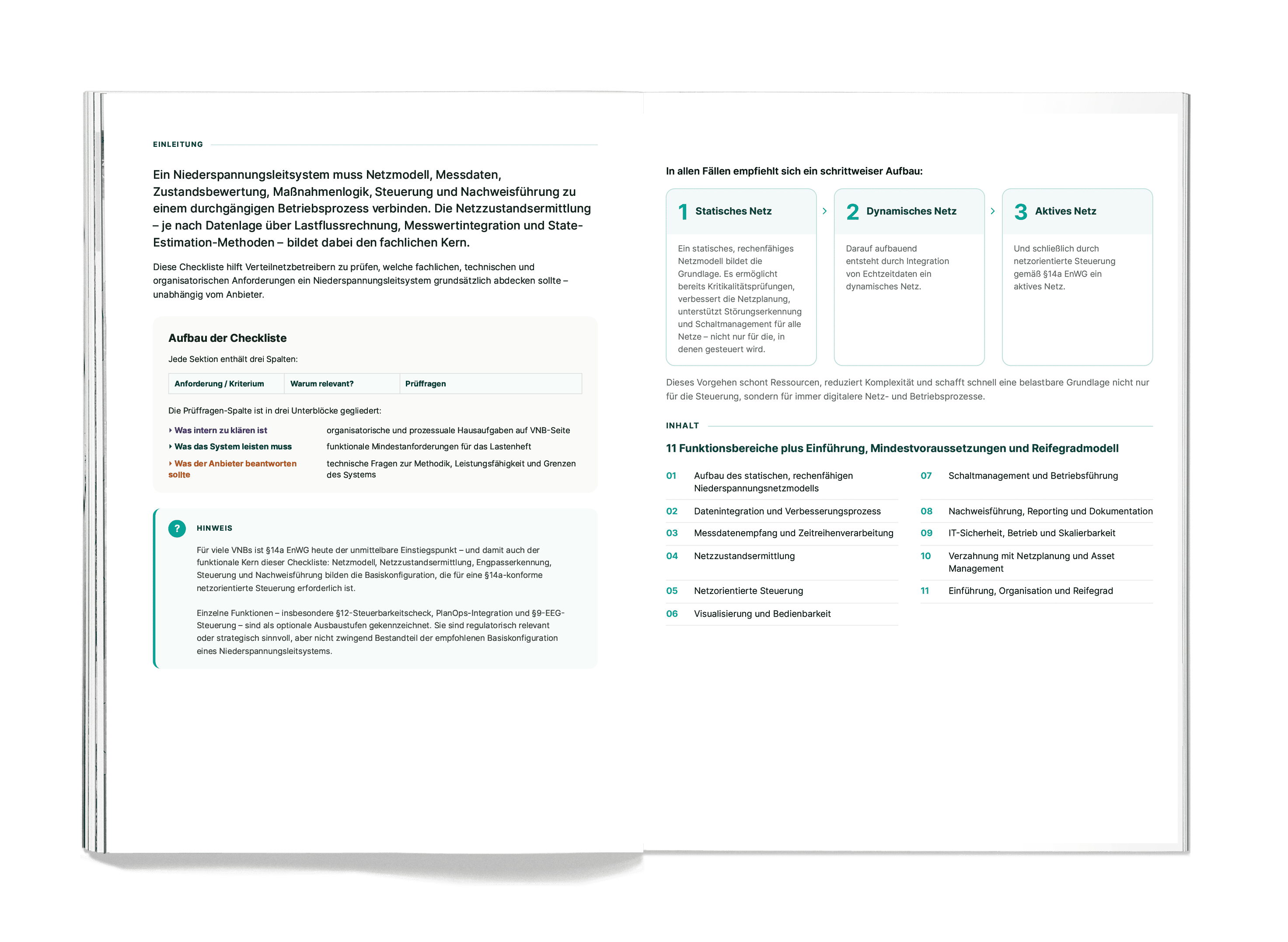
    Die Checkliste ist als praktischer Leitfaden für die Bewertung und Einführung eines Niederspannungsleitsystems aufgebaut. Statt abstrakter Funktionsbeschreibungen enthält sie konkrete Prüffragen, die bei internen Abstimmungen ebenso helfen wie im Gespräch mit potenziellen Anbietern.

    Was Du in der Checkliste u.a. findest:

    • Was intern zu klären ist, bevor das Projekt überhaupt ins Rollen gebracht wird
    • Welche Funktionen zur Basiskonfiguration gehören und was später folgen kann
    • Wie ein NS-SCADA-System mit fehlerhaften, verspäteten oder ausfallenden Messwerten umgehen muss
    • Welche Antworten ein Niederspannungsleitsystem-Anbieter liefern sollte
    Lade dir die Checkliste „Was ein Niederspannungsleitsystem wirklich leisten muss“ herunter.

    How is the digital twin created at envelio?

    digital-twin-creation-01

    At the heart of the digital twin is the GridHub – our platform that integrates, cleans, and transforms all grid data from various systems into a simulation-ready grid model.

    This is not a static data repository, but a dynamic, synchronized environment that continuously updates in response to changes in source systems.

    All applications within the Intelligent Grid Platform access this very model – consistently, version-controlled, and centrally managed.

    digital-twin-creation-02

    To build a high-fidelity digital twin of the grid, GridHub requires detailed input data of what is actually happening in the grid, including:

    • Grid topology and geo data – including normal switching states and feeder routes
    • Asset-specific details such as location, type, capacity, and current-carrying capability of cables, substations, and transformers
    • Information on grid participants such as PV systems, EV chargers, or heat pumps – including technical parameters and connection details

    These data points are collected from different source systems, including GIS, ERP, asset management systems, CRM platforms, and smart meter backends, and then united in the GridHub.
    digital-twin-creation-03

    Keeping a digital twin up to date requires reliable data flows from multiple systems. Standards like CIM or CGMES help in theory, but in practice they rarely enable seamless integration.

    That’s why we use a modular approach: systems are connected through reusable, tailored modules that ensure stable and transparent data integration without manual preparation.

    We handle the full setup – from interfaces to data delivery. Grid operators only need to provide access to their data, regardless of format.

    Thanks to this framework, we’ve successfully integrated more than 60 different systems to date, including GIS, ERP, and SCADA systems.
    digital-twin-creation-04

    Data issues often only become visible once everything is combined into a full grid model. What looks correct in isolation can break at system level.

    That’s why envelio uses a two-stage quality approach:

    1. Pre-checks before model creation

    Each dataset is automatically checked for completeness and plausibility. Inconsistencies – like unrealistic transformer capacities or missing mandatory fields – are flagged, and many of them can be corrected directly by the system.

    2. Validation of the complete grid model

    Once the data is merged, the grid structure is thoroughly validated. Are all grid areas connected properly? Any open ends or missing links? Automated checks – such as grid tracing and load flow simulations – are applied here. The latter help systematically uncover critical issues like non-converging networks or unrealistic loadings.

    GIS data, grid calculations, and SCADA – without a shared view?
    Our digital twin brings it all onto one platform. For consistent planning, reliable operations, and faster decision-making.

    Reservation management for planned projects

    Grid operators must often allocate capacity long before projects go live. The digital twin from envelio helps manage that proactively.

    Approved but not yet connected projects can be added as their own layer within the model – and so can planned grid reinforcement measures. Instead of managing this data in siloed tools, reservations and planned measures are embedded directly in the model, where they can be taken into account across all projects.

    This brings clarity, avoids double-reservations, and turns the grid model into a tool for anticipatory planning.

    Want to learn more?

    We’re happy to explore how a digital grid model can work in your existing system landscape – based on your current structure and challenges.

    Schedule a consultation from one of our experts – with no commitment.

    Ihr Kontakt

    Dr. Tobias Falke
    VP Global Sales & Marketing

    Tobias Falke envelio